Everything a West Virginia homeowner should know before hiring garage-door help: who's required to hold a license, how to verify one, what the codes say, and which local pages cover your city. One call connects you with an independent local pro: (888) 830-7442.

West Virginia requires a state contractor license, issued by the West Virginia Contractor Licensing Board within the Division of Labor, for construction work at or above statutory thresholds: licensing applies when a residential project totals $5,000 or more, or a commercial project totals $25,000 or more, under the West Virginia Contractor Licensing Act (now codified in Chapter 30, Article 42 of the state code). Many single garage door repairs fall under the residential threshold and can lawfully be performed unlicensed, but full door replacements or multi-door projects frequently cross it, and reputable companies hold a license regardless. Obtaining a license requires passing a business-and-law exam plus the relevant trade classification exam, registering with the Secretary of State and tax authorities, and carrying workers' compensation and unemployment coverage. Electrical work for openers also requires a West Virginia electrician's license. Homeowners can verify contractor licenses through the Division of Labor's online database search before signing a contract.
Verify before you hire: WV Division of Labor Contractor License Database Search. It takes a minute, it's free, and it's the single strongest scam filter available to a homeowner.
Permitting in West Virginia is local, and coverage is uneven: cities such as Charleston, Morgantown, and Huntington run full permit programs, while many rural counties have limited or no residential enforcement. Where codes are enforced, a like-for-like garage door replacement is typically exempt as ordinary repair, while enlarging an opening, replacing a header, or structural garage work requires a building permit, and new opener circuits require an electrical permit. Homeowners should check with their city or county office, since requirements differ significantly across the state.
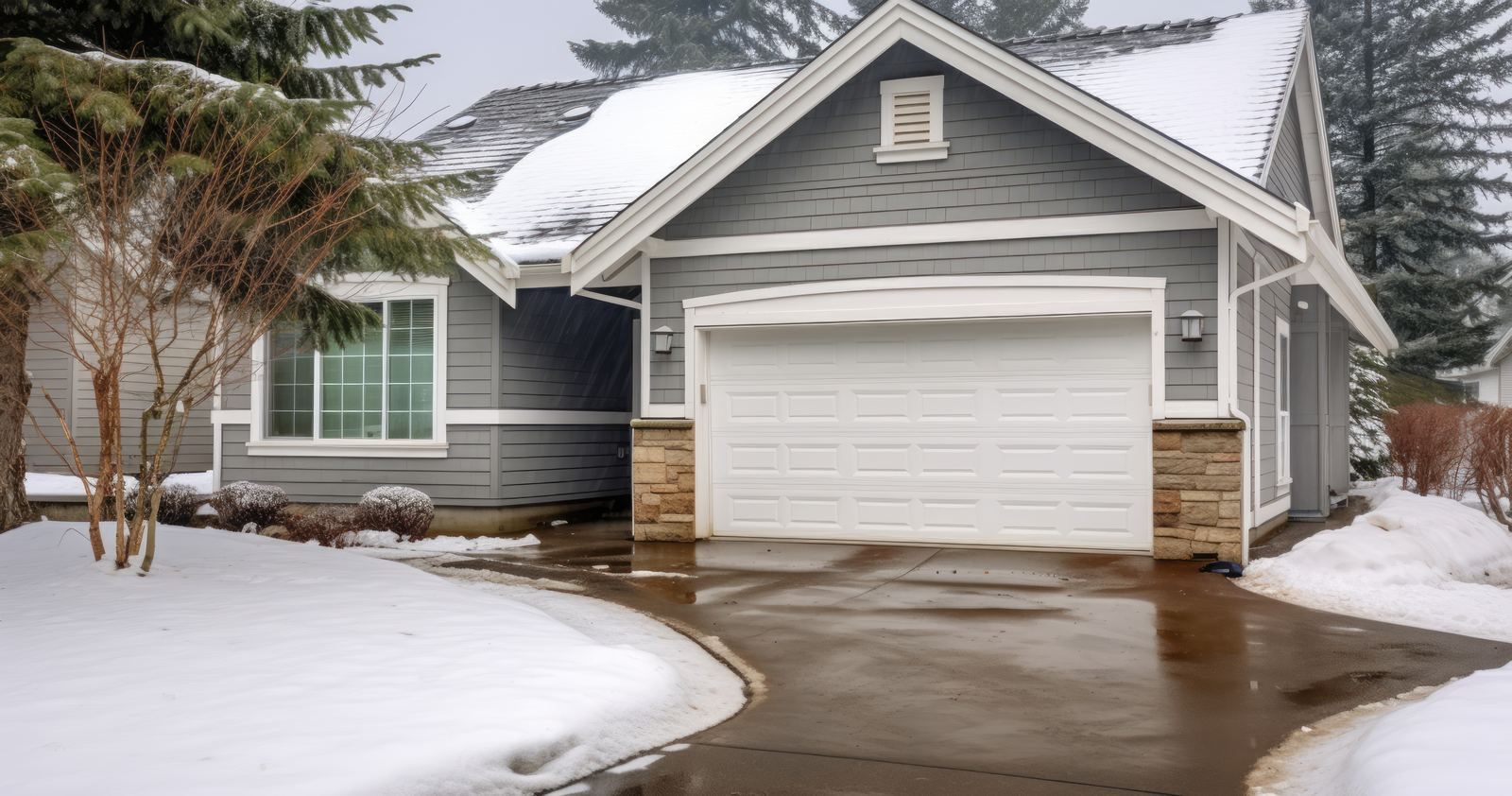
West Virginia's Appalachian terrain delivers cold, damp winters with frequent freeze-thaw cycling, especially in mountain counties, making late-winter spring failures the most common garage door emergency. High year-round humidity in the hollows and river valleys promotes rust on springs, cables, and tracks, and condensation in unheated garages accelerates hardware corrosion. Heavy snows and ice storms can freeze doors to slabs and strain openers, while frost heave shifts older garage slabs and misaligns tracks. Summer humidity swells wooden doors and jambs. Homeowners in mountain counties benefit from pre-winter lubrication and spring inspections, the highest-value preventive service in the state.
West Virginia's garage-door calendar peaks in the cold: spring steel fatigues in freezing temperatures, and the first hard snap of winter reliably snaps the season's first wave of torsion springs. If your door is heavy on the opener or twanging at the end of travel in the fall, that's the moment to act โ not January.
Your West Virginia garage door answers to Washington โ specifically, to a rule written in 1992. Since January 1, 1993, every residential opener sold in the U.S. must reverse automatically on contact with an obstruction โ entrapment protection required by UL 325 and 16 CFR Part 1211, standards written after documented child entrapment deaths.
Testing it costs nothing: a 2ร4 (or a roll of paper towels, per DASMA's gentler method) under the closing door must trigger an immediate reverse. No reverse, or no floor-level photo-eyes at all, means the system fails a standard that's been federal law since January 1993 โ fixable, usually in a single visit.
Sources: U.S. Consumer Product Safety Commission ยท UL Standards & Engagement ยท 16 CFR Part 1211 ยท DASMA
This industry's fake-storefront problem is real enough that search engines purge garage-door listings in waves. Five minutes of checking beats a driveway dispute every time.
Start with WV Division of Labor Contractor License Database Search. In a state without a blanket requirement, check whether your municipality requires local registration โ and treat voluntary credentials as a good-faith signal. Ask for the number over the phone; legitimate companies volunteer it.
Parts named, labor separated, warranty terms in writing โ before work begins. The signature scam in this trade is the advertised teaser fee that balloons on the driveway; a written quote is its natural enemy.
General liability and workers' comp protect you if a spring job goes wrong on your property. Reviews can be manufactured; certificates of insurance are harder to fake and any established West Virginia outfit can produce one.
Fake garage-door listings borrow retail addresses and virtual offices. Map the address you're given. A service-area business with no storefront can still be legitimate โ but it should say so plainly rather than borrowing someone else's building.
Deposits are normal for custom doors; full prepayment for a repair is not. Standard practice in West Virginia is payment on completion โ and a pro confident in their work has no reason to ask otherwise.
Every call type routes to an independent local professional โ ordered here by what West Virginia's climate actually breaks first.
Springs are mileage parts โ they end with a bang, not a whimper. Replacement is precision work under tension.
Learn more โTune-upLubrication, balance, force settings, and the safety-reverse test โ the honest checklist.
Learn more โOpenersFrom stripped gears to fried logic boards: real diagnosis before anyone names a part.
Learn more โCables & tracksThe unglamorous hardware that does the heavy lifting โ literally โ every single cycle.
Learn more โOff-trackA crooked door is one forced cycle away from a much bigger repair. Pros re-seat it safely.
Learn more โPanelsColor-matched sections for current models; honest advice when yours is discontinued.
Learn more โBig ticketThe biggest curb-appeal upgrade per square foot a house can get โ engineered, not just hung.
Learn more โ24/7Springs don't check the clock. Neither does the routing line.
Learn more โCommercialUptime matters when the door is how revenue enters the building.
Learn more โWeatherproofingA sealed, insulated door quiets the garage and steadies the temperature swing.
Learn more โSmartSee it, open it, close it from anywhere โ retrofits and full installs alike.
Learn more โStorm-ratedIn wind country the garage door is the wall that fails first. Rated doors change that math.
Learn more โIn our 39-state Garage Door Failure Risk Index, West Virginia ranks #8 of 39 with an index score of 60.4. The median West Virginia home was built in 1973 โ before the 1993 federal auto-reverse requirement, which means a meaningful share of openers here were never covered by the modern entrapment standard. About 71.1% of occupied homes are owner-occupied โ and owners, not landlords, make the maintenance decisions that keep doors alive.
The West Virginia garage-door year runs on a freeze calendar. Fall is the smart season: a tune-up, fresh lubrication rated for low temperatures, and a balance test before the first hard snap. Deep winter is spring-snap season โ steel fatigues fastest on the coldest mornings, which is why the year's first bitter week reliably brings a wave of one-car-stuck households. Spring thaw is the moment to check tracks and cables for salt-season corrosion, and summer is for the bigger projects: panel work, opener upgrades, and full replacements while the weather cooperates.
The biggest West Virginia markets we cover, with the full city list below. Each page carries local housing data, the free checks, and direct routing to a pro serving that area.
| City | Covered population | Median home built | ZIPs |
|---|---|---|---|
| Morgantown | 98,161 | 1984 | 7 |
| Martinsburg | 69,328 | 1997 | 5 |
| Wheeling | 40,445 | 1956 | 1 |
West Virginia requires a state contractor license, issued by the West Virginia Contractor Licensing Board within the Division of Labor, for construction work at or above statutory thresholds: licensing applies when a residential project totals $5,000 or more, or a commercial project totals $25,000 or more, under the West Virginia Contractor Licensing Act (now codified in Chapter 30, Article 42 of the state code). Use the official lookup to verify before hiring.
Use WV Division of Labor Contractor License Database Search โ the official lookup. A legitimate company will volunteer its credential number; hesitation is an answer too.
Permitting in West Virginia is local, and coverage is uneven: cities such as Charleston, Morgantown, and Huntington run full permit programs, while many rural counties have limited or no residential enforcement. Where codes are enforced, a like-for-like garage door replacement is typically exempt as ordinary repair, while enlarging an opening, replacing a header, or structural garage work requires a building permit, and new opener circuits require an electrical permit. Homeowners should check with their city or county office, since requirements differ significantly across the state.
West Virginia's garage-door calendar peaks in the cold: spring steel fatigues in freezing temperatures, and the first hard snap of winter reliably snaps the season's first wave of torsion springs.
Talk to a local garage-door pro now. Free to call, no obligation, honest answers โ the way it should be.