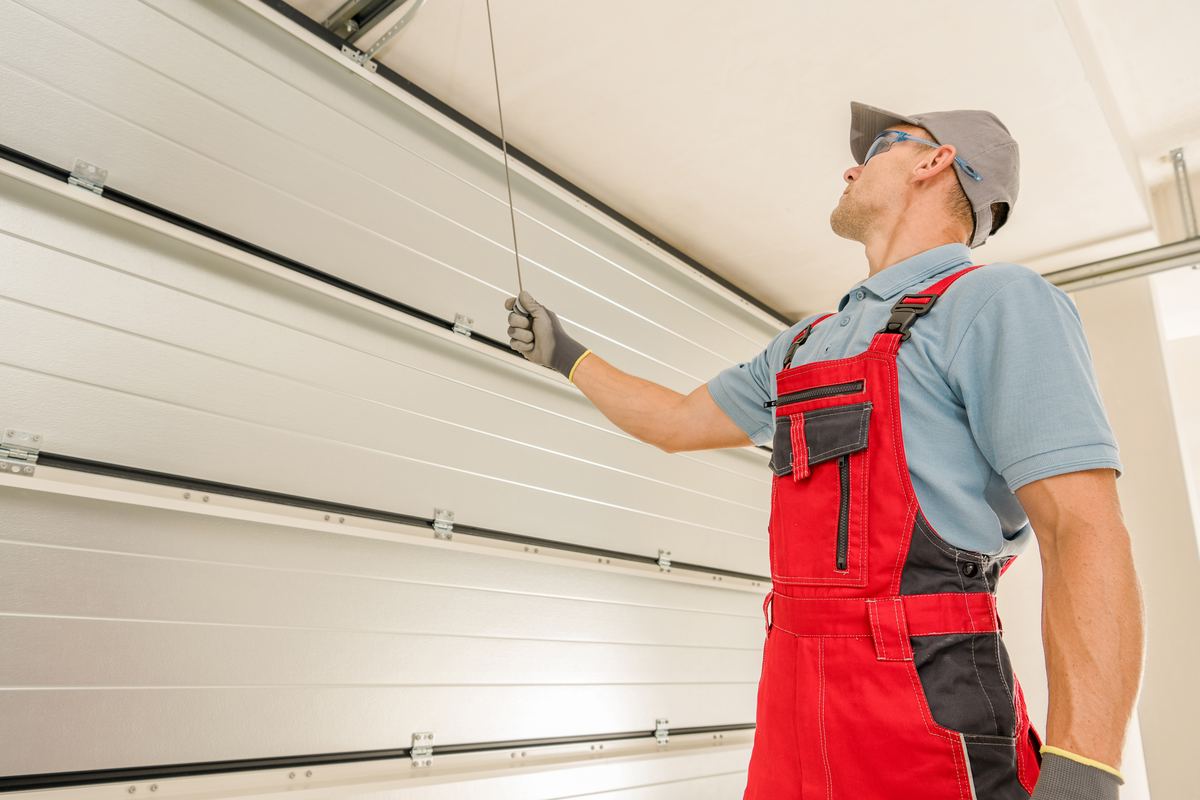
How do I know my garage door spring is broken?
The classic signature is a loud bang from the garage — homeowners often mistake it for something falling or even a break-in. Afterward, the door feels impossibly heavy, the opener strains and gives up a few inches off the floor, or the door rises crookedly. Walk in and look at the shaft above the door: on a torsion system, a broken spring shows a clean two-inch gap in the coil, as if someone cut it with shears. On an extension system, which runs along the horizontal tracks on either side, you may see a spring dangling or a safety cable holding loose pieces. Other tells include cables that suddenly look slack or have jumped off their drums, and a door that slams down faster than it should. If any of this matches, stop using the door. Every additional open-and-close cycle on a broken spring strains the opener, the cables, and the top panel — and turns a straightforward spring replacement into a longer repair list.
Torsion vs. extension springs: what is the difference?
Torsion springs mount on a steel shaft above the door opening. As the door closes, cables wound around drums at each end of the shaft twist the springs, storing energy; as the door opens, the springs unwind and do most of the lifting. Torsion systems offer smoother, more controlled travel and are the standard on most modern doors. Extension springs run parallel to the horizontal tracks and stretch as the door closes, pulling it back up through a pulley-and-cable arrangement. They are common on older doors and in garages with limited headroom above the opening. Extension systems must have safety cables threaded through each spring — without them, a snapped spring becomes a projectile. Many pros recommend converting older extension setups to torsion when the hardware allows, because torsion springs fail more predictably: they break in place on the shaft rather than flying loose. The professional we connect you with will identify your system on sight and carry parts for both.
Why is DIY spring repair genuinely dangerous?
This is not liability boilerplate — spring work injures do-it-yourselfers every year, and emergency rooms see the results: broken hands and forearms, facial injuries, and worse. A wound torsion spring on a typical double door stores enough energy to lift several hundred pounds seven feet in the air. Releasing or adding that tension requires solid steel winding bars of the correct diameter, a specific quarter-turn-at-a-time technique, and the experience to feel when something is binding. Substituting screwdrivers or rebar for winding bars is how most injuries happen. There is also a measurement problem: springs are specified by wire size, inside diameter, and length, and the correct spring must be matched to the door's actual weight — not guessed from the old part, which may itself have been wrong. An improperly matched spring makes the door too heavy or too light, wearing out the opener and creating a door that can fall unexpectedly. Professionals do this work daily with the right bars, the right springs on the truck, and a scale to weigh the door when needed.
What do spring cycle ratings mean?
One cycle is one full open and close. Most builder-grade torsion springs are engineered for roughly a ten-thousand-cycle service life — the industry's long-standing standard rating. That sounds like a lot until you do the math: a household that opens the door four to six times a day uses up a standard spring in well under a decade, and busy families with kids, multiple drivers, and the garage as the main entrance can get there far sooner. High-cycle springs, built with heavier wire or a longer coil, are rated for two or more times the standard life, with extended-life options rated higher still. Asking for a high-cycle spring at replacement time is one of the few genuinely worthwhile upgrades in this trade, because the labor is identical — the technician is already on the ladder. A good pro will ask how often you use the door and recommend a cycle rating honestly, rather than defaulting to the lowest-grade coil on the truck.
Should both springs be replaced at once?
On a two-spring torsion door, almost always yes — and not as an upsell. Both springs were installed the same day and have flexed through the same number of cycles. When one fatigues to the point of fracture, its twin is at the same point in its fatigue life, and pairing a fresh spring with a tired one puts uneven load on the new part and on the door. Replacing both restores balance and means one service visit instead of two in quick succession. The honest exception: if one spring is clearly newer than the other — a previous single-spring replacement — a good technician will say so and give you the choice. The same reasoning applies to extension springs, which are always replaced in matched pairs so both sides of the door pull evenly. While the technician has the door apart, expect them to check the center and end bearings and the cables, since a spring replacement is the most economical moment to address those wear items.
What happens during a professional spring replacement?
A competent technician starts by confirming the diagnosis and measuring — wire size, inside diameter, and overall length of the existing springs, plus the door's height and, when the old springs look mismatched, its actual weight. The door is clamped to the track so it cannot move, remaining tension is safely unwound with winding bars, and the old springs come off the shaft. New springs go on, cables are re-seated on the drums, and the springs are wound to the correct number of turns for the door height. Then comes the part that separates pros from parts-swappers: balancing. With the opener disconnected, a properly sprung door should stay put at knee height, waist height, and shoulder height, and lift with one hand. The technician then reconnects the opener, resets its force and travel limits to the newly balanced door, lubricates the springs and bearings, and cycles the door several times. Most residential spring replacements are completed in a single visit of about an hour, because the trucks carry a full range of spring sizes.