Everything a Florida homeowner should know before hiring garage-door help: who's required to hold a license, how to verify one, what the codes say, and which local pages cover your city. One call connects you with an independent local pro: (888) 830-7442.

Florida's rules changed substantially in 2024. House Bill 735 (2021) preempted local governments from requiring their own occupational licenses for many trades, including garage door installation, with the preemption taking full effect July 1, 2024 after HB 1383 extended the deadline. In place of the old city and county licenses, the state created a voluntary Certified Specialty Contractor license for garage door installation, issued by the Construction Industry Licensing Board (CILB) under the Department of Business and Professional Regulation (DBPR). Because the state credential is voluntary, a garage door company is not legally required to hold it, but many established firms do, and a DBPR license lets a contractor pull permits statewide. Garage door replacement in Florida typically requires a building permit, and permits generally must be pulled by a licensed contractor or by the homeowner acting as an owner-builder, which in practice pushes established installers toward state licensure.
Verify before you hire: DBPR Verify a License (MyFloridaLicense). It takes a minute, it's free, and it's the single strongest scam filter available to a homeowner.
Florida is stricter than most states: replacing a garage door generally requires a building permit because the door is part of the home's wind-resistant envelope under the Florida Building Code. The permit application typically must include the door's Florida Product Approval or Miami-Dade Notice of Acceptance showing its design-pressure rating for the site's wind speed. Local building departments issue the permit and inspect the installation. Repairs to springs, cables, and openers ordinarily do not require a permit.
Florida has the nation's most demanding garage door wind rules. Under the Florida Building Code, Eighth Edition (2023), effective December 31, 2023, garage doors must carry a state Product Approval or, in the High-Velocity Hurricane Zone covering Miami-Dade and Broward counties, a Miami-Dade Notice of Acceptance including large-missile impact resistance. In wind-borne debris regions along much of the coast, doors must be impact-rated or pressure-rated for design wind speeds that reach 170-plus mph in South Florida. Design-pressure documentation is a standard part of the permit file.
Florida is the highest-exposure state in the country for garage doors. Hurricanes are the defining risk: the door is the largest opening in the building envelope, and door failure during a storm can pressurize the house and lift the roof, which is why Florida's code treats garage doors as critical envelope components. Year-round humidity and salt air corrode springs, cables, rollers, and fasteners, especially within a few miles of either coast. Persistent heat shortens the life of opener electronics and lubricants. Freeze events are rare and minor. For most Florida homeowners, the practical priorities are a door rated for their wind zone and regular corrosion maintenance.
In Florida, the garage door is a structural decision, not just a convenience. Wind events find the largest opening in the house first, and a door that fails lets pressure inside the envelope โ the failure mode FEMA documents as a leading cause of catastrophic roof loss.
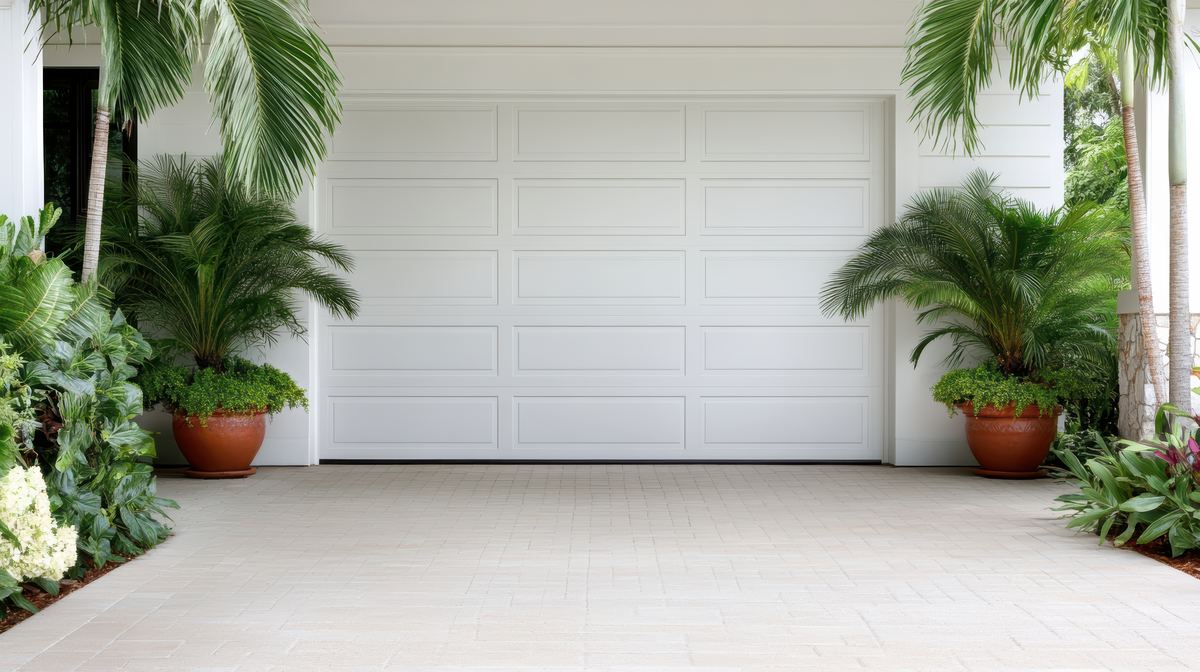
Your Florida garage door answers to Washington โ specifically, to a rule written in 1992. Since January 1, 1993, every residential opener sold in the U.S. must reverse automatically on contact with an obstruction โ entrapment protection required by UL 325 and 16 CFR Part 1211, standards written after documented child entrapment deaths.
Run the check this weekend: block the photo-eye beam while the door closes โ it should stop or reverse instantly. Then the 2ร4 contact test. A door that plows through either one is operating outside the federal entrapment standard, and bringing it current is one of the highest-value calls a garage-door pro makes.
Sources: U.S. Consumer Product Safety Commission ยท UL Standards & Engagement ยท 16 CFR Part 1211 ยท DASMA
This industry's fake-storefront problem is real enough that search engines purge garage-door listings in waves. Five minutes of checking beats a driveway dispute every time.
Start with DBPR Verify a License (MyFloridaLicense). In a state without a blanket requirement, check whether your municipality requires local registration โ and treat voluntary credentials as a good-faith signal. Ask for the number over the phone; legitimate companies volunteer it.
Parts named, labor separated, warranty terms in writing โ before work begins. The signature scam in this trade is the advertised teaser fee that balloons on the driveway; a written quote is its natural enemy.
General liability and workers' comp protect you if a spring job goes wrong on your property. Reviews can be manufactured; certificates of insurance are harder to fake and any established Florida outfit can produce one.
Fake garage-door listings borrow retail addresses and virtual offices. Map the address you're given. A service-area business with no storefront can still be legitimate โ but it should say so plainly rather than borrowing someone else's building.
Deposits are normal for custom doors; full prepayment for a repair is not. Standard practice in Florida is payment on completion โ and a pro confident in their work has no reason to ask otherwise.
Every call type routes to an independent local professional โ ordered here by what Florida's climate actually breaks first.
Miami-Dade approvals and wind-load labels are real engineering, not marketing.
Learn more โBig ticketFrom builder-grade steel to carriage-house statement doors โ installed to spec.
Learn more โMoney callThat bang from the garage? Spring steel reaching the end of its cycle rating. Pro territory, always.
Learn more โOpenersHums, clicks, half-lifts: opener symptoms decode fast under a trained eye.
Learn more โCables & tracksCables fray strand by strand until they don't. Catching them early is cheap insurance.
Learn more โOff-trackRollers out of the rail means stop โ using the door now turns a repair into a rebuild.
Learn more โPanelsDents, cracks, and rot handled section by section where the model allows.
Learn more โ24/7A door that won't close is an open invitation. Emergency routing exists for exactly this.
Learn more โCommercialService counters, firehouses, warehouses โ commercial doors earn their keep daily.
Learn more โWeatherproofingDaylight under the door means weather, dust, and pests have a standing invitation.
Learn more โTune-upTwenty minutes a year keeps the thousand-cycle machine honest.
Learn more โSmartBattery backup, camera models, keypads โ the garage joins the smart home properly.
Learn more โIn our 39-state Garage Door Failure Risk Index, Florida ranks #31 of 39 with an index score of 34.4. The median Florida home was built in 1988 โ before the 1993 federal auto-reverse requirement, which means a meaningful share of openers here were never covered by the modern entrapment standard. About 66.9% of occupied homes are owner-occupied โ and owners, not landlords, make the maintenance decisions that keep doors alive.
The Florida calendar bends around storm season. Late spring is preparation time: wind-rating checks, bracing hardware, and seal inspections before the season peaks. During storm months the emergency calls run to doors that failed under pressure or lost power mid-cycle โ battery-backup openers earn their keep here. The cooler months are the window for the structural work: rated-door replacements and reinforcement retrofits are far easier to schedule when the forecast is calm, and installers' calendars agree.
The biggest Florida markets we cover, with the full city list below. Each page carries local housing data, the free checks, and direct routing to a pro serving that area.
| City | Covered population | Median home built | ZIPs |
|---|---|---|---|
| Miami | 1,849,309 | 1977 | 95 |
| Orlando | 1,072,954 | 1993 | 59 |
| Jacksonville | 945,632 | 1986 | 48 |
| Fort Lauderdale | 849,882 | 1979 | 47 |
| Tampa | 826,077 | 1984 | 55 |
| Hollywood | 465,344 | 1975 | 13 |
| West Palm Beach | 388,455 | 1981 | 17 |
| Pompano Beach | 380,985 | 1980 | 14 |
| Saint Petersburg | 357,666 | 1971 | 24 |
| Hialeah | 351,492 | 1976 | 10 |
| Naples | 335,771 | 1996 | 17 |
| Kissimmee | 285,825 | 2002 | 6 |
Florida's rules changed substantially in 2024. Use the official lookup to verify before hiring.
Use DBPR Verify a License (MyFloridaLicense) โ the official lookup. A legitimate company will volunteer its credential number; hesitation is an answer too.
Florida is stricter than most states: replacing a garage door generally requires a building permit because the door is part of the home's wind-resistant envelope under the Florida Building Code. The permit application typically must include the door's Florida Product Approval or Miami-Dade Notice of Acceptance showing its design-pressure rating for the site's wind speed. Local building departments issue the permit and inspect the installation. Repairs to springs, cables, and openers ordinarily do not require a permit.
In Florida, the garage door is a structural decision, not just a convenience.
Talk to a local garage-door pro now. Free to call, no obligation, honest answers โ the way it should be.