📚 Field Guide
Why Garage Doors Fail First in Hurricanes
FEMA calls the garage door one of a home's largest, most vulnerable openings. What wind ratings mean, who needs Miami-Dade approval, retrofit vs. replace.
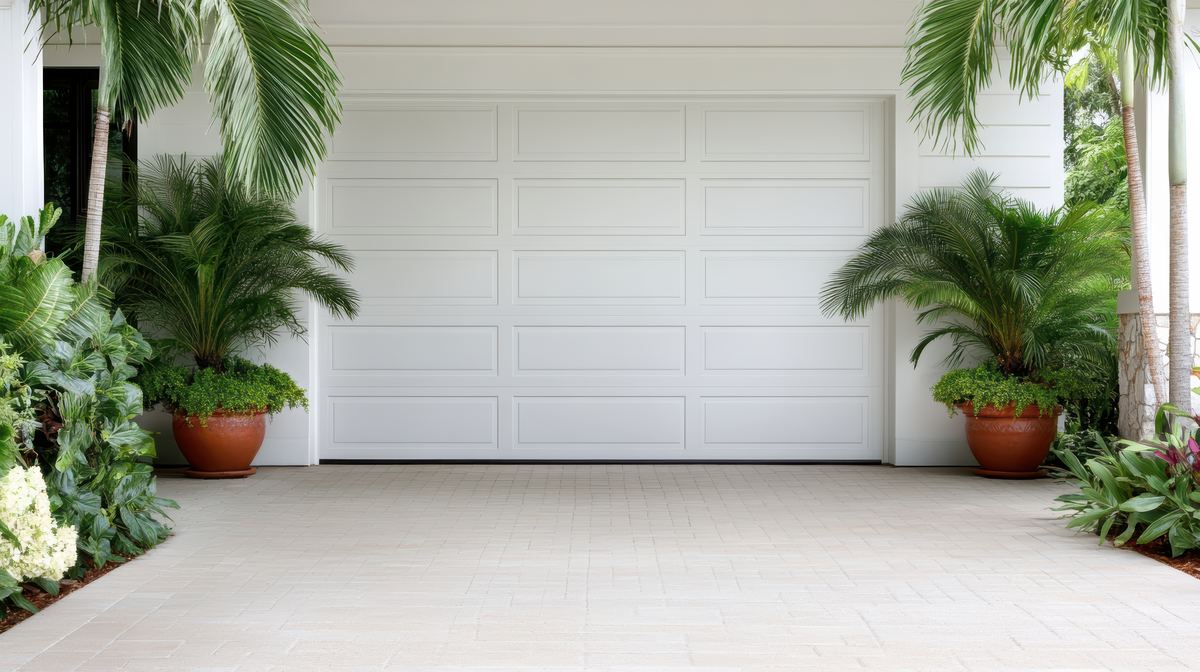
FEMA calls the garage door one of a home's largest, most vulnerable openings. What wind ratings mean, who needs Miami-Dade approval, retrofit vs. replace.
When engineers walk neighborhoods after a hurricane, the garage door comes up again and again in damage assessments, and the reason is geometry before it is anything else. FEMA's wind retrofit guidance puts it plainly: garage doors can be relatively large, making them one of the largest openings in a building, and that expanse of thin, hinged material is asked to resist the same wind pressures as the surrounding wall while being, by design, a moving panel on rollers in light-gauge tracks. FEMA describes the failure modes bluntly: wind can blow garage doors in, pull them out by suction, or twist them off their tracks. A standard non-rated door is built to keep out weather and burglars, not to behave like a structural wall in extreme wind. Double-car doors are the worst case, because pressure on a door scales with its area and a sixteen-foot-wide door has an enormous sail area with support only at its edges and rollers. None of this is a defect in your door; it is what non-rated doors are for and not for. The problem is what happens to the rest of the house in the seconds after the door gives way, which is why this single component has earned so much attention from FEMA, insurers, and building codes.
The garage door matters far beyond the garage because of what wind does once it gets inside. When a door blows in during a hurricane, the opening suddenly lets wind pressurize the interior of the building. That internal pressure pushes upward and outward on everything from the inside, at the same time the storm is pulling on the roof and walls from the outside, and the combined loading is a well-documented trigger for catastrophic failures: roof decking peeling away, gable ends collapsing, and in bad cases progressive failure of the whole structure. This is the mechanism behind the standard guidance from FEMA and from the insurance-industry research community that protecting openings, and the garage door above all because of its size, is one of the highest-leverage wind mitigation steps a homeowner can take. It also explains a persistent myth worth retiring: cracking a window or door to equalize pressure does not help and makes things worse, because a sealed envelope is precisely the goal. There is a second, quieter failure chain, too: a breached garage exposes everything in it, cars, tools, water heaters, and the house door into the living space, to wind and driven rain for the remaining hours of the storm. The door is not just protecting a parking spot. It is holding the envelope closed.
Wind-rated doors are described by design pressure, expressed in pounds per square foot as a positive number, resistance to wind pushing in, and a negative number, resistance to suction pulling out. Those values come from structural testing under recognized standards, and the industry association DASMA publishes technical data sheets that translate the wind speeds and exposure categories in building codes into required design pressures for a given door size and site. Building codes based on the international residential and building codes, which incorporate the ASCE 7 wind load standard, determine what your location requires; coastal maps step the requirements up sharply. Two ratings often get conflated and should not be. Wind-load rating means the door resists pressure. Impact rating means the door has additionally passed missile-impact and cyclic-pressure testing, certifying it can take a strike from windborne debris and keep resisting pressure afterward. In debris-prone coastal zones, codes require openings to be impact-protected, either by an impact-rated door or by adding a tested shutter system over a pressure-rated door. When you shop or compare quotes, the honest questions are: what are the positive and negative design pressures, what code and wind speed was that based on for my address, and is the door impact-rated or pressure-rated only. A legitimate dealer answers all three from the door's approval documents, not from memory.
You will see Miami-Dade approved used as a badge in garage door marketing nationwide, so here is what it really means. Florida's building code designates a High-Velocity Hurricane Zone, HVHZ, covering Miami-Dade and Broward counties, with the most stringent wind and debris-impact requirements in the country. Products installed there need a formal approval, most famously a Miami-Dade Notice of Acceptance, NOA, which certifies that a specific door model, size, and installation detail passed the required pressure and large-missile impact testing. Florida also runs a separate statewide product approval system for areas outside the HVHZ. If you live in those two counties, this is not optional: your door must carry the appropriate approval, and the installation must match the approved drawings, down to fasteners and track details, because the certification covers the assembly, not just the panels. If you live elsewhere on the hurricane coast, from the rest of Florida through the Gulf and up the Atlantic seaboard, your local code sets the requirement, generally by wind speed zone rather than HVHZ rules, and a Miami-Dade NOA is best understood as evidence of a very robust door rather than a legal requirement. Inland, a rated door can still make sense in tornado-prone or severe-thunderstorm regions, but nobody should be selling HVHZ compliance to a homeowner in Ohio as if it were mandated.
You have two real paths, and the right one depends on your door, your zone, and your budget priorities, not on a sales script. Retrofitting means reinforcing your existing door: add-on bracing kits and center posts that stiffen the door against pressure, hardware upgrades to heavier tracks, brackets, and additional rollers, or a tested shutter or screen system installed over the opening. FEMA's retrofit guidance describes these options and flags the honest catch with the most common one: removable center-post bracing is an active measure, meaning it protects you only if someone is home, remembers, and installs it before the storm, and it addresses pressure but not debris impact. Retrofit kits also change your door's weight and balance, so springs typically need adjustment, and a braced non-rated door still is not a certified assembly. Replacement means a factory wind-rated or impact-rated door, engineered and tested as a complete assembly with its tracks and fasteners, which is passive protection: it works whether or not you are home, and it is what carries formal approvals. Our honest read: if your door is old, single-skin, or due for replacement anyway, replacing with a rated door is clearly the better value; if your door is newer and sound, a documented, code-recognized retrofit can be a legitimate interim step. What is not legitimate is a scare pitch that skips the retrofit conversation entirely.
Plain guidance, by situation. If you are in the Florida HVHZ, this is settled law: your door needs the appropriate approval, and your only real decision is which approved door and installer. If you are in a coastal wind-borne debris region anywhere from Texas to New England, a wind-rated door, impact-rated or paired with tested opening protection, is one of the highest-value mitigation investments on the house, and it may also earn wind-mitigation credits on your homeowners insurance; ask your insurer what documentation they require before the job, not after. If you are inland but in severe-wind country, a pressure-rated door is a judgment call worth pricing when your current door reaches end of life, since the upgrade cost is smallest at replacement time. Wherever you live, three free actions today: find your door's rating, on a label on the inside of the door or in its paperwork, and if there is no label, assume it is not rated; check your address's design wind speed through your local building department; and if a storm is approaching with a non-rated door in place, park the cars outside the garage or well clear of the door, and do not rely on the opener to hold the door. Then, if you decide to act, apply the same vetting we preach everywhere: written quotes, real approval documents, and no fear-first sales tactics.
FEMA identifies the garage door as one of the largest openings in a home, vulnerable to being blown in, sucked out, or twisted off its tracks in high wind.
A failed garage door lets wind pressurize the house from inside, a documented trigger for roof and structural failure, which is why opening protection is such high-leverage mitigation.
Wind-load rating and impact rating are different certifications, and Miami-Dade NOA approval is legally required only in Florida's High-Velocity Hurricane Zone.
Retrofit bracing is a legitimate documented option but is active protection with real limits; a factory-rated replacement door protects passively and carries the formal approvals.
Sources: FEMA P-2181 Fact Sheet 3.2, Wall Systems and Openings · FEMA training on hurricane wind mitigation measures · Building America Solution Center, Garage Doors are Pressure Rated · Published 2026-07-14
Talk to a local garage-door pro now. Free to call, no obligation, honest answers — the way it should be.